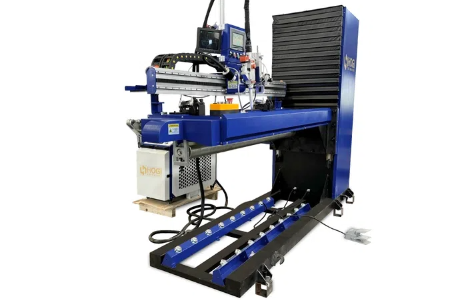
Longitudinal Seam Welding Machine is specialized equipment used in the manufacturing of steel tubes and pipes. These machines are designed to join the edges of metal strips along their length, creating a continuous and strong welded seam. They are widely used in industries such as construction, automotive, oil and gas, and manufacturing, where high-quality welded tubes and pipes are essential.
Overview of Longitudinal Seam Welding Machines
Longitudinal seam welding machines operate on the principle of creating a weld along the longitudinal edges of metal strips. The process involves forming a flat steel strip into a cylindrical shape and welding it continuously along the seam using techniques such as electric resistance welding (ERW) or high-frequency welding (HFW). The welded tube is then sized, cut, and finished according to the required dimensions. These machines enable efficient production of pipes with consistent strength, smooth surface finish, and dimensional accuracy.
Components of a Longitudinal Seam Welding Machine
A longitudinal seam welding machine consists of several key components that work together to ensure high-quality welding. The entry section typically includes uncoilers and straighteners that feed the steel strip into the forming section. The forming section bends the strip into a cylindrical shape using rollers. The welding section applies heat or electrical current to create a strong, continuous seam. Post-weld, the tube passes through sizing rolls to achieve the desired diameter and shape, followed by a cutting unit to produce tubes of specific lengths. Additional components may include cooling systems, inspection units, and control panels for monitoring the entire process.
Materials and Welding Methods
Longitudinal seam welding machines can process various types of steel, including carbon steel, alloy steel, and stainless steel. The choice of material depends on the application requirements, including strength, corrosion resistance, and durability. Welding methods such as electric resistance welding and high-frequency welding are commonly used. ERW uses electric current to heat and fuse the edges, while HFW utilizes high-frequency electrical currents to create a weld, allowing for higher production speeds and precise seam control.
Applications Across Industries
Longitudinal seam welded tubes and pipes have applications in multiple industries. In construction, they are used for scaffolding, structural supports, and pipelines. The automotive industry uses them for chassis components, exhaust systems, and hydraulic lines. Oil and gas industries rely on welded pipes for transporting liquids and gases. Additionally, furniture, mechanical engineering, and general manufacturing industries utilize longitudinal seam welded pipes for various structural and functional purposes.
Advantages of Longitudinal Seam Welding Machines
Longitudinal seam welding machines offer high production efficiency, precise seam quality, and consistent tube dimensions. They allow continuous operation, minimizing downtime and material waste. Automation and advanced control systems enhance precision and repeatability, ensuring uniform weld strength and surface finish. These machines are versatile and capable of producing tubes in various diameters, wall thicknesses, and materials, catering to diverse industrial needs.
Maintenance and Operational Considerations
Regular maintenance is essential for ensuring the optimal performance of longitudinal seam welding machines. Components such as rollers, welding electrodes, and cutting units require periodic inspection, cleaning, and calibration. Operators must monitor welding parameters, temperature, and strip alignment to maintain seam quality. Manufacturers often provide technical support, spare parts, and training to optimize operation and extend machine lifespan.
Conclusion
Longitudinal seam welding machines are critical in the production of high-quality welded tubes and pipes for various industries. By combining precise forming, welding, and finishing processes, these machines deliver durable and accurate products. With efficient operation, versatility, and reliable seam quality, longitudinal seam welding machines continue to play a vital role in modern tube and pipe manufacturing.