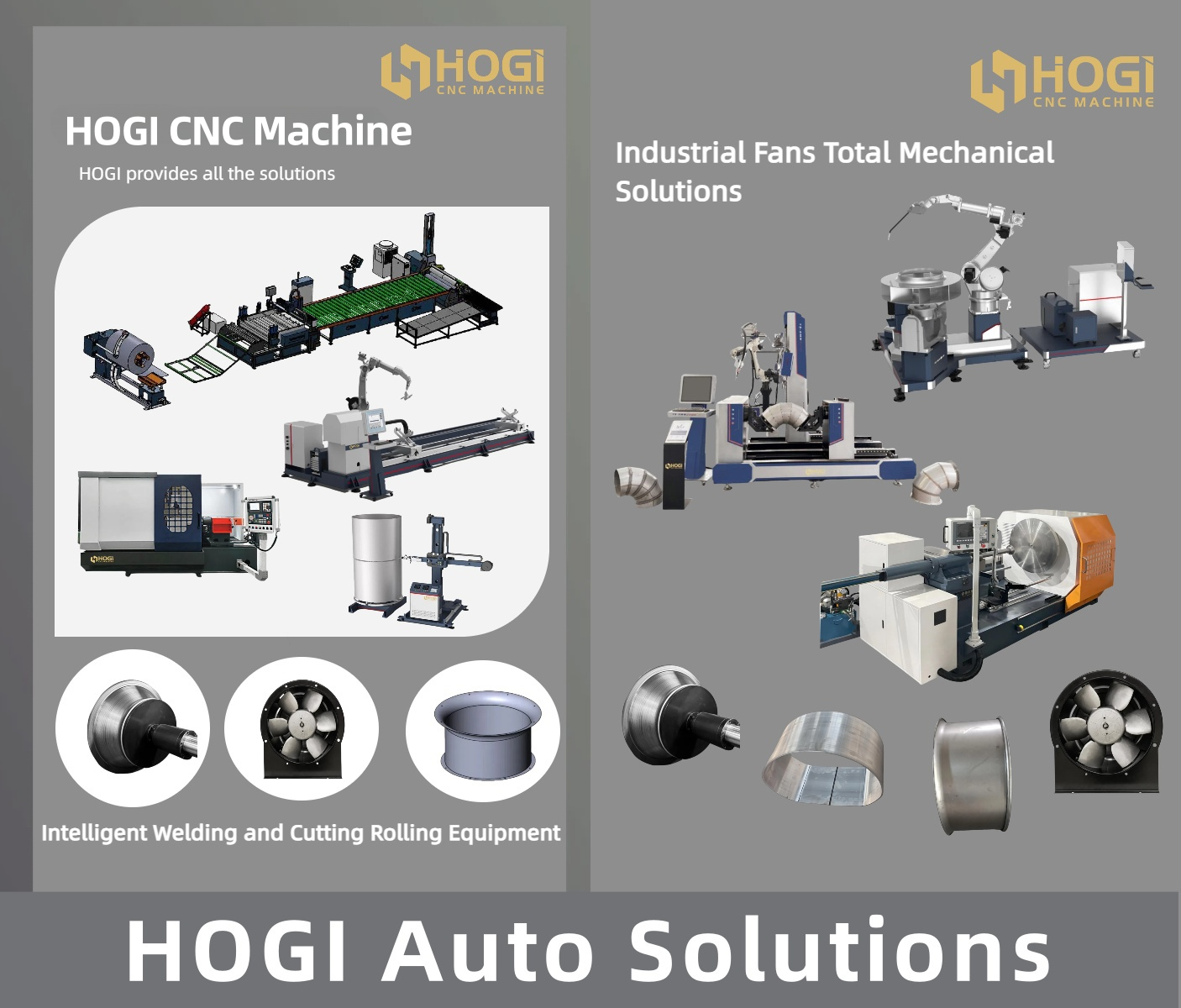
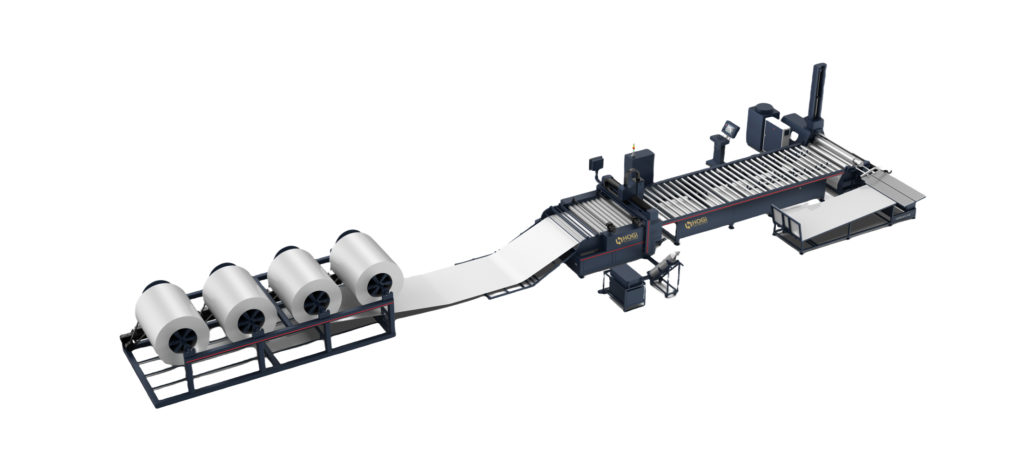
— Coil Uncoiling, Leveling, Laser Cutting, and Blanking Line
Fully automated laser cutting production lines for metal coils are an indispensable part of modern manufacturing, garnering significant attention for their high precision, high efficiency, and wide range of applications. This article will provide an in-depth exploration of the composition, operating principles, advantages, and applications of these production lines across various industries, offering readers a comprehensive understanding.
A fully automated production line for laser cutting and blanking of metal coils typically consists of several key units, including an uncoiling unit, a leveling unit, a laser cutting unit, a cutting-off unit, a hydraulic system, and a pneumatic control system. These units are centrally controlled via a PLC module, enabling the automated operation of the entire production line.
The uncoiling unit is the starting point of the entire production line and is responsible for uncoiling metal coils. This unit typically has a high load capacity and is capable of handling heavy coils. On the fully automated production line designed by HOGI CNC, the uncoiling unit can handle coils weighing up to 20 tons and is equipped with auxiliary loading and unloading mechanisms, which greatly facilitate operation.
The leveling unit follows immediately after the uncoiling unit, and its primary function is to level the uncoiled metal coil. The leveling unit typically employs a roller-type leveling mechanism, allowing the gap between the upper and lower rollers to be adjusted manually or automatically to accommodate coils of varying thicknesses. With its fast leveling speed and high efficiency, it ensures the smooth progression of the subsequent cutting process.
The laser cutting unit is the core component of the entire production line. It uses a high-energy laser beam to precisely cut metal coils. When the laser beam is focused, its energy becomes highly concentrated, rapidly heating the target area and causing the material to vaporize. Because the energy is so concentrated, only a small amount of heat is transferred to other parts of the material, resulting in minimal distortion. The laser cutting unit can perform automated cutting according to pre-programmed instructions, ensuring high precision and efficiency. Furthermore, laser cutting does not require dies, enabling the processing of complex-shaped blanks and offering a high degree of flexibility.
The cutting unit is responsible for cutting the pre-cut blanks to the required lengths. The hydraulic and pneumatic control systems provide power and control support for the entire production line, ensuring that all units operate in coordination.
Fully automated laser cutting production lines for metal coils offer numerous advantages. First, they enable automated production, significantly improving production efficiency. The entire production line requires no manual intervention and can be operated by a single person, significantly reducing labor costs. Second, the production line offers high precision and stability, ensuring consistent and reliable product quality. Laser cutting technology, with its high precision and burr-free characteristics, demonstrates unique advantages in the metal processing industry. Additionally, the production line offers high flexibility, allowing for customized designs to meet the specific production requirements of various industries. Fully automated laser cutting production lines for metal coils have found widespread application across multiple industries. In the automotive manufacturing sector, these production lines can efficiently and accurately cut automotive components—such as body panels and chassis parts—significantly improving production efficiency and quality. In the aerospace industry, these production lines are capable of cutting complex-shaped aircraft components, such as wings and fuselages, ensuring aircraft performance and safety.
In the precision instrument manufacturing industry, laser cutting production lines for metal coils have become the equipment of choice for manufacturing precision components due to their high precision and burr-free cutting capabilities. In the architectural cutting decoration industry, these production lines can cut metal decorative panels of various shapes and sizes—such as ceiling panels and wall panels—to meet the diverse needs of architectural decoration.
In addition to the industries mentioned above, fully automated production lines for laser and blanking of metal coils also play a significant role in many other fields. For example, in the electronics industry, these production lines can cut metal foils of various shapes and sizes for use in the manufacture of electronic components. In the energy sector, they can cut metal coils used to manufacture components such as solar panels and wind turbine blades.
It is worth noting that fully automated production lines for laser cutting and blanking of metal coils are still undergoing continuous development and refinement. With the ongoing advancements in optoelectronic technology, laser technology is also constantly innovating and improving. For example, some advanced laser cutting equipment is now capable of achieving higher cutting speeds and better cutting quality, further enhancing production efficiency and product quality. In addition, some manufacturers are developing more intelligent production lines by incorporating cutting technologies such as artificial intelligence and big data to enable intelligent control and management of the production lines, thereby enabling intelligent control and management of the production lines. further reducing labor costs and improving production efficiency.
The development of fully automated production lines for laser cutting and blanking of metal coils has not only driven progress in the manufacturing sector but has also provided strong support for the transformation and upgrading of various industries. By adopting these advanced production lines, companies can significantly improve production efficiency and product quality, reduce costs, and enhance their market competitiveness. At the same time, the intelligent and customizable design of these production lines offers companies greater flexibility, meeting the diverse production needs of different industries.
In summary, fully automated production lines for laser cutting and blanking of metal coils have become an indispensable part of modern manufacturing due to their high precision, high efficiency, wide range of applications, and continuous development and improvement. With ongoing technological advancements and expanding applications, these production lines are expected to play an even more significant role in the future, injecting new vitality into the development of the manufacturing industry.
HOGI Metal Coil Processing Machine
A leveling line, also known as a leveling and shearing line, uncoiling line, or cross-cutting line, is a type of custom-made metal coil processing equipment. It is primarily used by companies engaged in the deep processing of steel coils and in the white goods manufacturing sector, and is widely applied across numerous industries, including automotive, container manufacturing, home appliances, food packaging, construction, metallurgy, petrochemicals, shipbuilding, and pressure vessels. The production cycle typically spans several months, and the equipment must be customized according to specific client requirements.
This equipment processes metal coils—such as cold-rolled and hot-rolled carbon steel and silicon steel—into flat sheets through processes including uncoiling, leveling, slitting, and shearing. The process also includes both longitudinal and transverse shearing. Core modules include the uncoiler, leveling machine, and shearing machine. A complete production line also includes components such as a stock pile, conveyors, and stackers, and can be equipped with an electrical control system to enable automation.
A leveling line, also known as an uncoiler line (OPEN CONVEYOR), cross-cutting line, or uncoiling, leveling, and shearing line, is used to process metal coils of various specifications through processes such as uncoiling, leveling, slitting, and cross-cutting. It shears the material into flat sheets of the required length and width, which are then rewound or stacked. This production line features a high degree of automation and high production efficiency. It can process cold-rolled and hot-rolled coils, silicon steel sheets, stainless steel sheets, color-coated sheets, aluminum sheets, as well as various types of metal sheets that have undergone electroplating or coating. It is widely used in metal sheet processing industries such as automotive, agricultural vehicles, containers, home appliances, food, packaging, and building materials. While the initial investment is generally substantial, the return on investment is balanced. A standard production line consists of a stock pile, feed cart, auxiliary support, uncoiler, telescopic blade, leveling machine, loop, side guide, five-roll rough leveling and cutting machine, shearing machine, conveyor, stacking rack, and discharge cart. Specific configurations can be customized according to customer requirements. For most companies, the production process—from customer customization to product shipment—takes several months; therefore, this is considered non-standard, custom-made equipment.
Structure and Operating Principles
A coil processing line, also known as an uncoiling, leveling, and shearing line or a cross-cutting line, is an automated production line that processes coiled metal stock through operations such as uncoiling, leveling, and cut-to-length shearing to produce flat sheets of the required length and width, which are then rewound or stacked. This production line is widely used in the metal sheet processing industry, including the automotive, home appliance, packaging, and building materials sectors.
Equipment Composition
The core equipment of a leveling line typically includes an uncoiler, a leveling machine (or straightening machine), a feeder (usually servo-driven), a shearing machine (cross-cut shear), and an electrical control system. Depending on customer requirements and the production line’s process configuration, optional equipment such as a loading cart, conveyor belt, and stacker can be added. A standard production line typically consists of a stock pile, feed cart, uncoiler, leveling machine, shear, conveyor, and stacking rack. Common types of uncoilers include single-drum cantilever, single-drum cantilever-supported, and double-cone disc types. Taking the single-drum cantilever-supported type as an example, it primarily consists of a frame, an AC variable-frequency motor drive, a hydraulic expanding mandrel, and an automatic centering device (CPC). It can process coiled material with a thickness of 0.4–3.5 mm and a coil weight of up to 22 tons. Some production lines utilize a leveling, feeding, and shearing machine, which integrates leveling, feeding, and shearing functions into a single unit, helping to save floor space.
Workflow
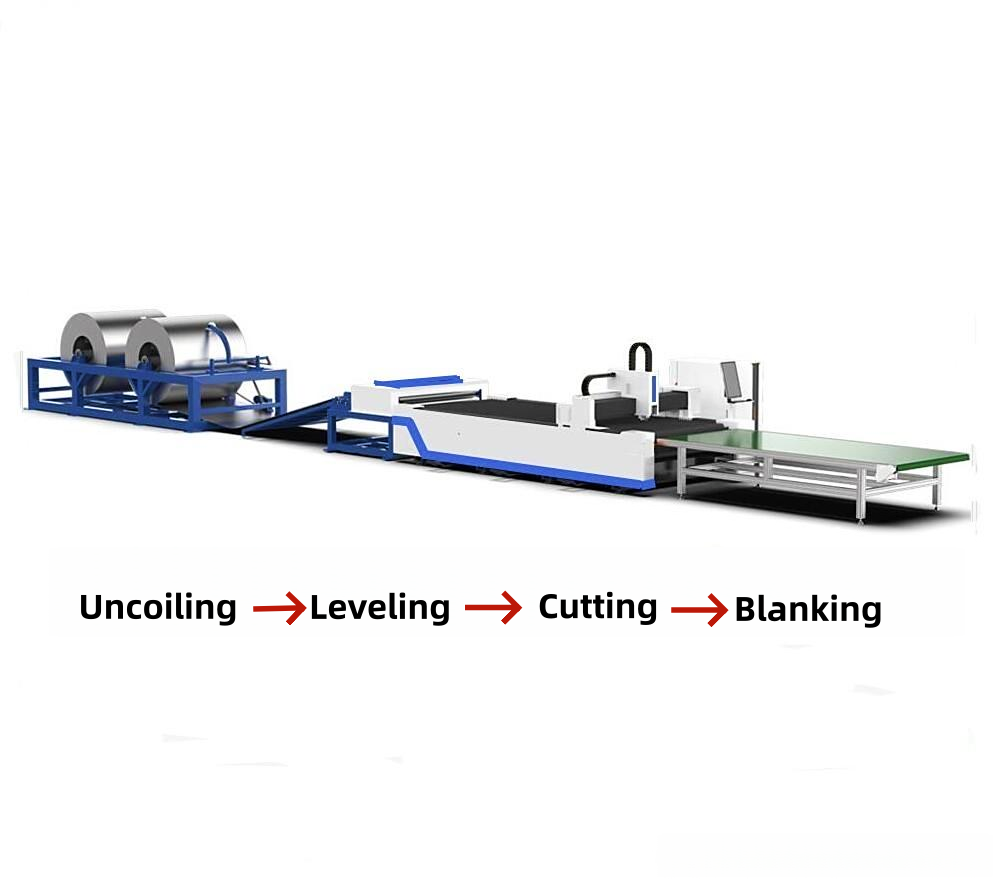
The basic workflow of a slitting line consists of: unloading and uncoiling, leveling, servo feeding and cut-to-length, cross-cutting, conveying and stacking (or rewinding). The entire process can be automated for continuous production.
Technical Features
Modern leveling lines are typically driven by servo motors and equipped with a fully automatic touchscreen control system that supports both Chinese and English user interfaces. Operators can easily set and adjust parameters via the touchscreen. This equipment is characterized by high efficiency, high precision, scratch-free sheet leveling, low noise, and a low failure rate. The feed pitch can be flexibly adjusted to enable synchronized shearing with the shearing machine, ensuring the quality of the sheet surface.
Application areas:
Uncoiling lines are suitable for steel coil processing companies, white goods manufacturers, and similar businesses; they serve as auxiliary processing equipment for steel. As custom-built equipment, uncoiling lines typically have a production lead time of several months and are configured according to specific customer requirements.
Roll forming is widely used in numerous industries, including automotive, container manufacturing, home appliances, food packaging, construction, boiler manufacturing, metallurgy, petrochemicals, shipbuilding, pressure vessels, interior decoration, metal structures, and machinery manufacturing.
Fully automatic steel plate leveling lines are core equipment in industries such as sheet metal fabrication, steel structure manufacturing, and automotive parts processing.
HOGI Laser Uncoiling and Blanking Line
As a core piece of equipment for upgrading sheet metal processing, the HOGI laser uncoiling and blanking line integrates key modules such as an intelligent uncoiling system, a precision leveling unit, a high-speed servo feeding mechanism, and a laser system. It enables fully automated production from steel coil to finished cutting parts in a single, integrated process, comprehensively addressing the processing needs of the sheet metal industry, precisely resolving key industry challenges, and empowering businesses to enhance efficiency.
- Mold-free, flexible production tailored to the needs of high-mix, low-volume manufacturing
By completely eliminating the high upfront costs and cumbersome debugging processes associated with traditional stamping dies, Ruigao Laser’s coil-uncoiling and blanking line allows for one-click switching of part designs. This enables rapid adaptation to sheet metal production scenarios involving multiple product varieties and small batch sizes, significantly shortening the time-to-market for new sheet metal products. As a result, it helps companies respond quickly to market changes, seize market opportunities, and enhance their core competitiveness.
- High-precision cutting and forming eliminate the need for subsequent finishing processes. Leveraging the precision leveling and high-speed laser cutting technologies of the uncoiling, leveling, and laser cutting line, the process delivers smooth, burr-free cuts with minimal heat-affected zones and high flatness. After cutting, agricultural machinery structural components require no additional processing and can proceed directly to welding and coating, completely eliminating the need for manual grinding and finishing. This not only significantly improves processing efficiency but also effectively ensures product precision and consistency.
- End-to-End Automation Delivers Significant Cost Savings and Efficiency Gains From uncoiling, leveling, and feeding to laser cutting and palletizing, the laser uncoiling and blanking line operates with end-to-end automation. This drastically reduces labor requirements, effectively cutting labor and management costs, while significantly boosting sheet metal production efficiency. It quickly alleviates order delivery pressures, helping companies increase production capacity, optimize operating operational models, and lower overall costs.