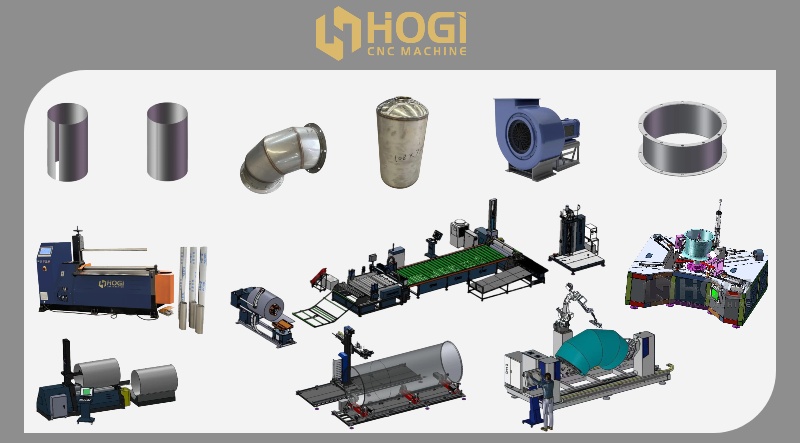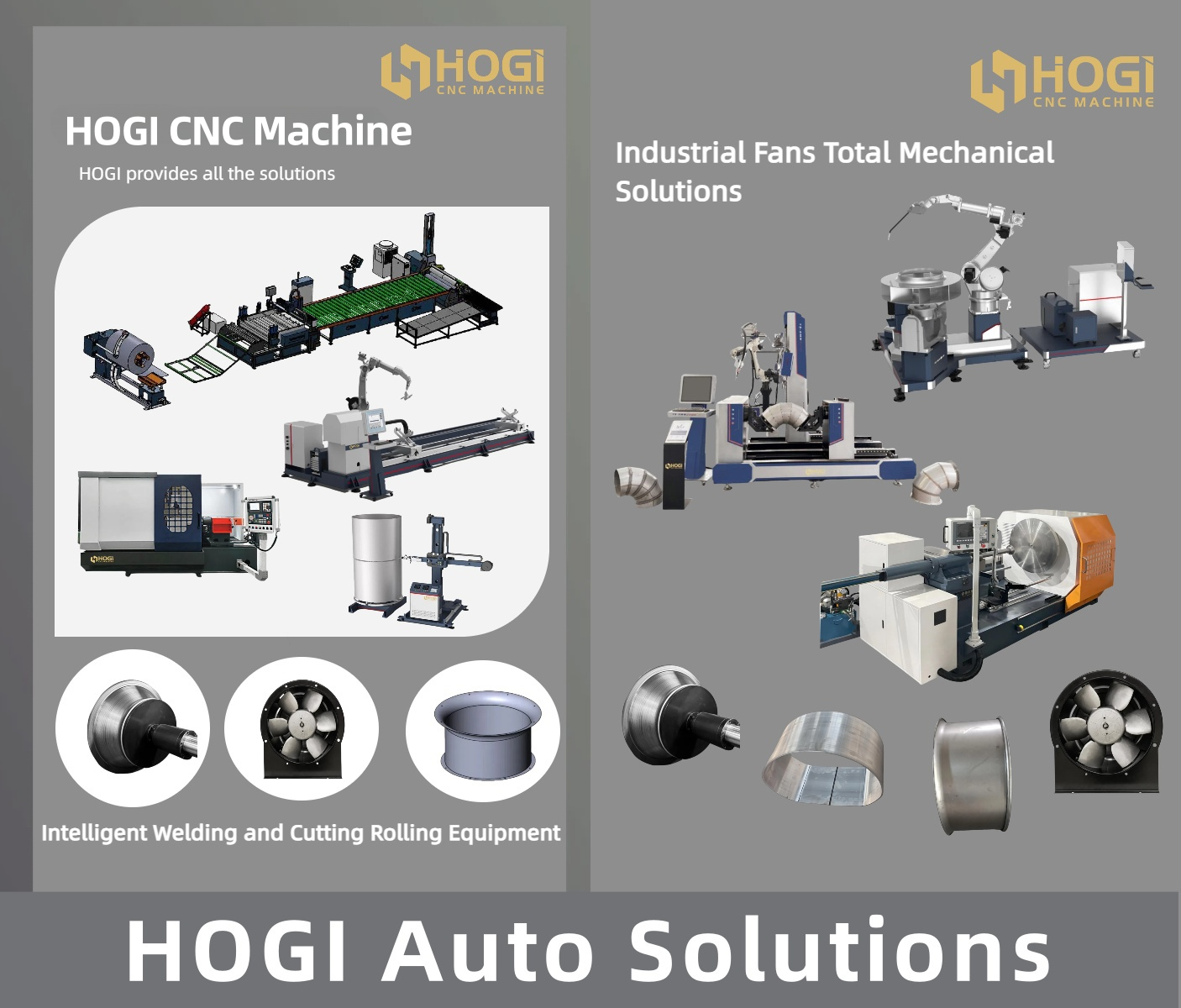
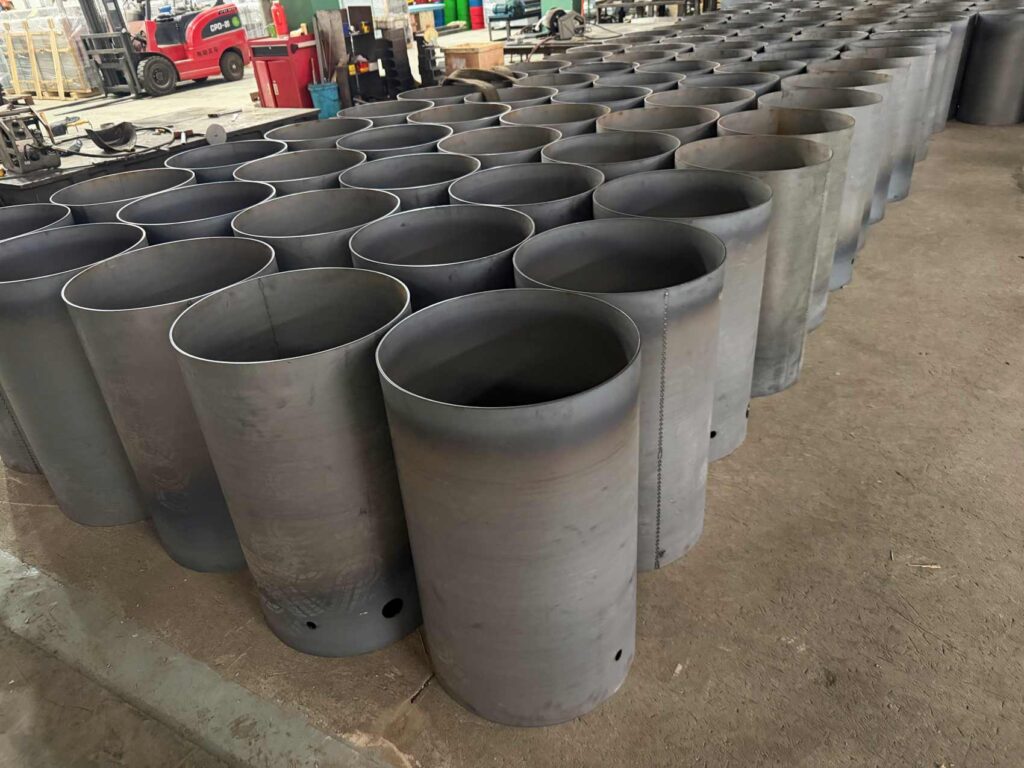
The process comprises two main automated welding methods: longitudinal seam welding (welding the longitudinal seam after rolling the cylinder plate) and circumferential seam welding (joining cylinder sections, or welding the cylinder to end caps/flanges). The fully automated production line integrates loading, rolling, and unloading capabilities, making it suitable for cylindrical workpieces such as pressure vessels, water tanks, storage tanks, pipelines, mixing tanks, and gas storage tanks.
一,Preliminary material preparation process (upstream off-line process)
1. Material Cutting: Laser, plasma, or shearing machines are used to cut steel plates for the cylinder body, ensuring straight edges and consistent bevel dimensions; V- or X-shaped welding bevels are machined on thick plates, while thin plates are left unbeveled.
2. Bevel Preparation: Automatic edge milling machines are used to mill the bevels and remove mill scale and burrs, ensuring a uniform weld gap to prevent defects such as porosity and lack of fusion.
3. Plate Leveling: A leveling machine eliminates plate waviness and distortion, preventing edge misalignment and uneven weld widths during the subsequent rolling process.
二,Cylinder Rolling and Fit-up (Preparation for Longitudinal Seam Welding)
1. Automatic Plate Rolling: The steel plate is fed into a four-roll CNC plate rolling machine; the rolling curvature is controlled by the CNC system to form a standard cylinder in a single pass, with straight edges reserved at both ends to prevent edge collapse.
2. Pre-assembly of Longitudinal Seams
Option 1: Specialized longitudinal seam assembly fixture; hydraulic pressure clamps the mating edges to control the misalignment (offset) to within 0.5–1.5 mm (depending on wall thickness standards).
Option 2: Pneumatic magnetic positioning fixture; designed specifically for thin-walled stainless steel cylinders.
3. Tack Welding for Positioning: Automatic TIG or MAG tack welding is performed at intervals along the seam to secure the assembly and prevent cracking or misalignment during the subsequent welding process; for long cylinders, multiple tack welds are applied evenly.
三,Fully automatic longitudinal seam welding for cylindrical shells
Equipment: Longitudinal seam automatic welding machine (TIG / SAW / Plasma welding)
1. Cylinder Loading / Fixture Placement: The cylinder is placed into the longitudinal seam welding fixture, which features a water-cooled copper backing. Hydraulic clamps lock the cylinder in place, ensuring the weld seam aligns tightly with the conductive copper backing to prevent burn-through and deformation.
2. Automatic Seam Tracking and Positioning: A laser seam tracker scans the weld gap and center position, automatically aligning the welding torch; the system matches welding parameters based on the cylinder’s thickness and material.
3. Automatic Continuous Welding:
· Thin-gauge stainless steel / Pure water tanks: DC pulsed TIG welding (single-side welding with double-side bead formation);
· Thick-walled carbon steel pressure vessels: High-penetration, high-efficiency submerged arc welding (SAW); the welding torch travels at a constant speed while the water-cooled backing provides synchronous cooling to control thermal deformation.
4. Post-weld Preliminary Cooling and Unclamping: The entire longitudinal seam is welded in a single pass; the fixture is then released, and the cylinder is removed from the welding station.
四,Shell section rounding and grinding processes
1. CNC Roundness Correction: Longitudinal welding causes deformation in the cylinder body; a CNC external rolling machine is used to correct roundness, ensuring minimal misalignment during subsequent circumferential seam fit-up.
2. Weld Grinding and Cleaning: An automatic abrasive belt grinding machine removes weld beads, spatter, and oxide layers from longitudinal seams to ensure a tight fit during circumferential seam assembly; stainless steel cylinders undergo polishing.
五,Automatic circumferential fit-up of shell sections/cylinders and end caps (heads)
1. Workpiece Rotation & Fixturing: A single shell section plus a head (or two shell sections) is hoisted onto the welding rotator (comprising drive and idler CNC roller units); the rollers support the shell and facilitate uniform rotation.
2. Automatic Hydraulic Fit-up & Clamping: An axial clamping device pushes the head (or the other shell section) into contact; a laser system measures misalignment, and hydraulic controls make micro-adjustments to the shell’s position to ensure the circumferential misalignment falls within specified limits.
3. Circumferential Tack Welding: An automatic welding torch performs uniform tack welding around the circumference to secure the relative position of the head and the shell.
六,Fully automatic circumferential welding (core process for circumferential welds)
Equipment: CNC turning rolls + automatic circumferential welding machine (submerged arc welding / TIG welding / gas-shielded welding)
1. Welding Program Selection: Preset parameters—including current, voltage, rotation speed, and torch oscillation amplitude—are automatically retrieved based on the cylinder’s diameter, wall thickness, and material. For thick plates, the process involves multi-pass layered welding comprising root, fill, and cap passes.
2. Real-time Laser Seam Tracking: As the cylinder rotates at a constant speed, a laser sensor tracks the weld seam center in real time. The welding torch automatically makes micro-adjustments (left/right) to compensate for cylinder roundness errors and assembly misalignments.
3. Automated Layered Welding:
Root Pass: Low-current TIG welding ensures full root penetration, eliminating lack-of-penetration defects.
Fill/Cap Passes: High-current Submerged Arc Welding (SAW) or Gas Metal Arc Welding (GMAW) with mixed shielding gas ensures efficient filling, while slight torch oscillation widens the weld bead; an optional torch lifting mechanism automatically adjusts the welding height for each layer.
七,Automated welding of attachment welds (heads/flanges, supports, and nozzles)
1. Flange circumferential welds: Small positioner + automatic welding torch; single-pass formation of the short circumferential weld between the flange and the cylinder.
2. Nozzle fillet welds: CNC cross-slide automatic welding; saddle-shaped nozzle welds performed with weaving motion.
3. Automatic tack welding / full welding of legs and lifting lugs using specialized tooling.
八,Post-weld inspection and post-processing
1. Online Visual Inspection: Vision cameras scan weld seams to detect surface defects such as porosity, undercut, and incomplete fill.
2. Non-Destructive Testing (Mandatory for pressure vessels): Automated X-ray or ultrasonic equipment scans longitudinal and circumferential seams to detect internal cracks and slag inclusions.
3. Stress Relief (For thick-walled pressure vessels): Automated heat treatment equipment performs low-temperature stress-relief annealing to release residual welding stresses and prevent cracking during service.
4. Grinding, De-rusting, and Coating Transfer: An automatic shot-blasting machine removes mill scale from the vessel shell before it is conveyed to the coating line.
九,Integrated full-line automation capabilities (unmanned production line configuration)
1. Automated workpiece loading/unloading via overhead crane or forklift-mounted manipulator;
2. MES data acquisition: records welding parameters, welding duration, and flaw detection results, ensuring full product traceability;
3. Automatic fault alarms: real-time shutdown triggered by wire breakage, weld seam deviation, or roller overload;
4. Multi-specification program storage: one-touch parameter switching for different tank diameters and wall thicknesses.
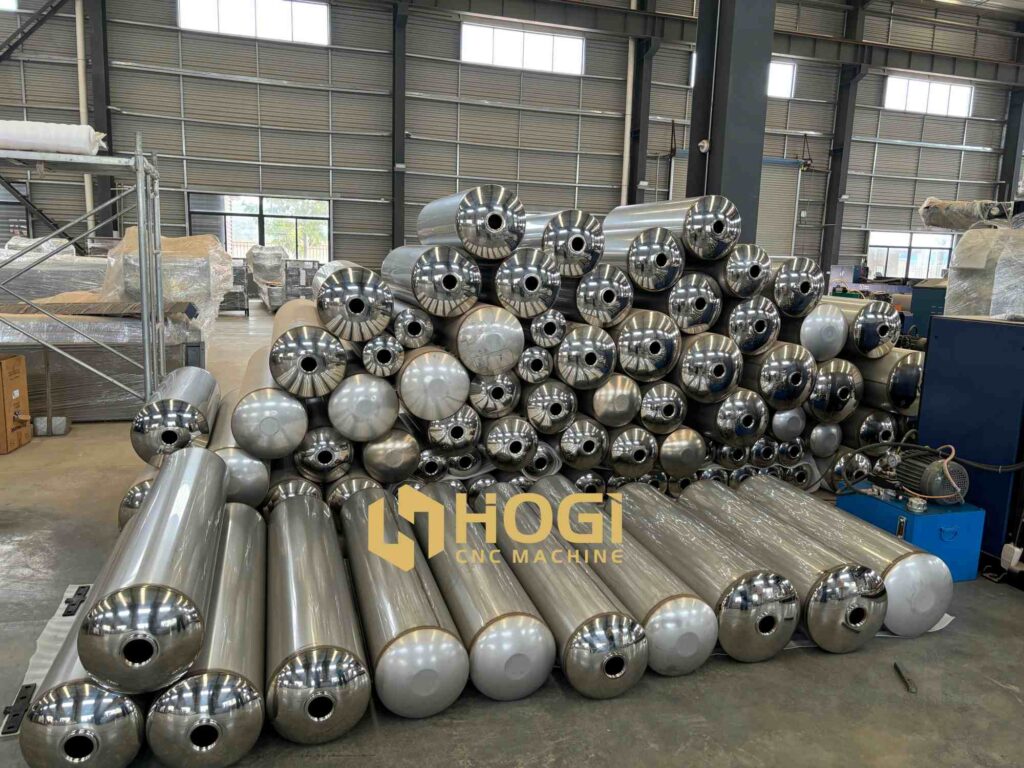
Core Advantages of Fully Automatic Tank/Cylinder Welding Equipment (Longitudinal Seam Welder + Automatic Circumferential Welding System with Turning Rolls)
*Weld quality is stable, and the pass rate has increased significantly.
1. Constant and Controllable Welding Parameters: Current, voltage, travel speed, oscillation amplitude, and vessel rotation speed are all digitally controlled and locked. This eliminates issues common to manual welding, such as unsteady technique, inconsistent pressure, or fluctuating speeds. The weld penetration is uniform, with no missed welds, lack of fusion, slag inclusions, or porosity.
2. Real-Time Laser Seam Tracking and Compensation: Sensors automatically fine-tune the welding torch position to compensate for vessel roundness errors or assembly misalignment, ensuring precise seam tracking throughout the process. This prevents off-center welding and incomplete penetration on one side, significantly increasing the first-pass success rate for pressure vessel flaw detection.
3. Standardized Multi-Layer Welding: For thick-walled pressure vessels, the system automatically performs root, fill, and cap passes with uniform layer thickness. For thin-walled stainless steel tanks, it achieves single-sided welding with double-sided penetration, resulting in a uniform back-side bead free of oxidation pits.
4. Uniform and Aesthetic Weld Appearance: The weld ripples are neat and consistent in width, with minimal spatter. This drastically reduces the time required for post-weld grinding and polishing, easily meeting aesthetic standards for food-grade, water treatment, and stainless steel storage tanks.
*Production efficiency is doubled, enabling continuous, unmanned operation.
1. Continuous welding eliminates equipment fatigue issues; straight longitudinal seams and full circumferential seams are completed in a single pass. Unlike manual welding—which involves frequent breaks and adjustments—automated welding increases speed by 50%–200% for identical workpieces.
2. One-touch program switching for various specifications: Parameters for cylinders of different diameters and wall thicknesses are pre-stored, allowing for instant program recall when changing models. This eliminates the need for skilled welders to repeatedly perform test welds and parameter adjustments, reducing changeover time by over 70%.
3. Integration with automated logistics enables unmanned night-shift production: When paired with overhead cranes, automated tooling, and loading/unloading robots, the system requires only periodic inspections at night, boosting total production capacity without increasing labor costs.
4. Multi-process integration minimizes idle time: Seamlessly linking rolling, fit-up, longitudinal welding, and circumferential welding into a continuous production line reduces waste associated with workpiece transfer, clamping, and waiting.
*Reduce reliance on highly skilled certified welders and save on labor costs.
1. Low operational threshold: Standard operators only need to handle loading/unloading, program startup, and routine inspections; they do not require pressure vessel welding certification. This addresses industry pain points such as the difficulty of recruiting welders, high labor costs, and the significant loss of young talent.
2. One operator for multiple machines: A single worker can simultaneously oversee 2–3 sets of automatic longitudinal and circumferential welding systems, whereas traditional manual methods require a dedicated professional welder for each shell welding machine.
*Reduce labor intensity and improve workshop safety conditions.
1. No manual lifting or rotating of the workpiece: The roller stand automatically drives the vessel to rotate at a constant speed, eliminating the need for manual prying or flipping of large, heavy tanks and preventing risks such as lower back strain or injuries from falling heavy objects.
2. Workers kept away from intense light, fumes, and high heat: The welding torch travels automatically while the operator monitors from a distance, significantly reducing occupational health risks such as arc burns, inhalation of welding fumes, and heat exposure.
3. Comprehensive safety features: The equipment is equipped with overload protection, emergency stop functions, anti-collision mechanisms, and light-shielding guards; it automatically stops and triggers an alarm in the event of workpiece slippage, misalignment, or wire breakage, leading to a significant reduction in safety accidents.
*Greater savings on sheet materials and consumables, reducing production costs.
1. Stable heat input and controllable deformation: Stainless steel tanks utilize water-cooled copper backing, while thick carbon-steel tanks undergo uniform, multi-layer welding; this significantly reduces ovality and warping, thereby eliminating substantial costs associated with correction and rework.
2. Economical consumption of welding wire and shielding gas: Parameters are precisely matched, avoiding the waste often caused by manual habits of welding at excessively high currents; reduced spatter leads to lower wire consumption.
3. Extremely low rework and scrap rates: Manual welding often results in defective seams due to operator fatigue or poor visibility, necessitating grinding, repair welding, or even scrapping of the material; in contrast, automated welding offers high consistency, drastically reducing the number of parts that fail non-destructive testing and saving on steel and labor costs.
*Digital management and control, production traceability; tailored for the pressure vessel industry.
1. Automatic recording of full-process welding data: Real-time storage of parameters—such as current, voltage, welding duration, cylinder rotation speed, and torch oscillation—with integration into MES systems.
2. Full traceability of product quality: Special equipment (e.g., pressure vessels, air storage tanks) requires archived welding records prior to dispatch; the automated system generates welding process reports that meet quality supervision and customer acceptance standards.
3. Visualized production data management: Automatic tracking of production output, yield rates, and equipment utilization rates, facilitating production scheduling, cost accounting, and order management.
Fully automatic welding equipment for cylindrical shells/tanks—suitable industries (longitudinal seam welding + circumferential roller seam welding)
1. Pressure Vessel / Air Receiver Industry
Products: Air receivers, hydraulic accumulators, nitrogen/oxygen pressure vessels, boiler shell sections, buffer tanks. Suitability: Special equipment regulations require weld flaw detection and stable penetration; manual welding suffers from high rework rates. Automated welding ensures consistent weld quality and data traceability, meeting inspection standards; submerged arc welding (SAW) significantly boosts efficiency for thick-walled shells.
2. Water Treatment / Stainless Steel Water Tank Industry
Products: 304/316 stainless steel insulated water tanks, purified water tanks, filtration tanks, wastewater reaction vessels. Suitability: Thin-walled stainless steel shells require single-sided welding with double-sided penetration and aesthetically pleasing, oxidation-free welds. Longitudinal welding with water-cooled backing and circumferential welding with laser tracking minimize the need for grinding and polishing; high-volume, standardized tank production creates a strong demand for automation.
3. New Energy Storage Industry
Products: Liquid-cooled energy storage tanks, electrolyte storage tanks, battery cooling shells, hydrogen storage vessels for refueling stations. Suitability: Stainless steel or aluminum alloy materials require exceptional sealing integrity, with zero tolerance for micro-porosity in welds. Automated multi-layer welding combined with real-time tracking ensures extremely low defect rates and supports stable, high-volume production.
4. Chemical Mixing Equipment Industry
Products: Chemical reactors, mixing vessels, anti-corrosion storage tanks, dilution/mixing tanks. Suitability: Large-diameter, long cylindrical shells involve multiple circumferential welds and nozzle-to-shell (saddle) welds; manual workpiece rotation is labor-intensive. CNC turning rolls provide automatic rotation, while cross-slide welding units handle nozzle welding, making the process ideal for mass production.
5. HVAC and Heating Equipment
Products: Heat exchanger shells, water manifolds/distributors, boiler heat exchange cylinders, insulated air duct cylinders. Suitability: Standardized cylinder specifications with multiple circumferential seams; automatic welding ensures uniform forming, reduces rework due to leaks, and integrates seamlessly with assembly lines.
6. Construction Machinery and Hydraulics
Products: Hydraulic cylinder barrels, construction machinery fuel tanks, lubricant storage cylinders, equipment dust collection cylinders. Suitability: Thick-walled carbon steel cylinders requiring high weld strength; submerged arc automatic welding provides deep penetration and high reliability under heavy-load conditions.
7. Water Supply and Firefighting Equipment
Products: Firefighting pressure-stabilizing tanks, non-negative pressure water supply tanks, pressurized water supply cylinders, pipeline expansion cylinders. Suitability: High-volume production for civil applications requires strict control over leakage defects; automated welding offers stable control over thermal deformation.
8. Grain, Oil, and Food Processing Equipment
Products: Edible oil storage tanks, fermentation cylinders, food mixing tanks, stainless steel material hoppers. Suitability: Sanitary-grade stainless steel; smooth welds with minimal spatter reduce the need for post-weld polishing; automatic welding eliminates manual oil contamination, meeting acceptance standards for food-grade equipment.
9. Pipeline Manufacturing
Products: Spiral welded pipe sections, straight-seam steel pipes, short pipe butt-welding cylinders. Suitability: Batch production of standard pipe sections; integrated automatic welding for longitudinal and circumferential seams; compatible with pipe production lines.