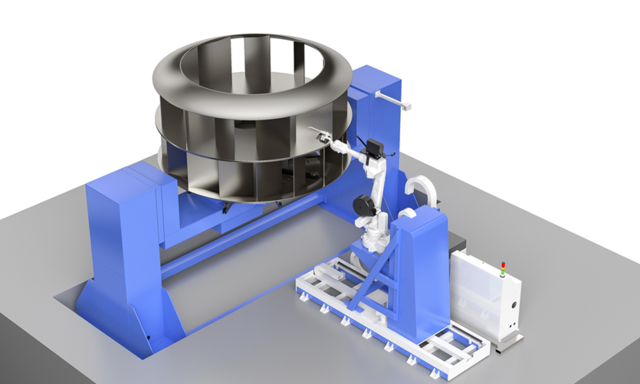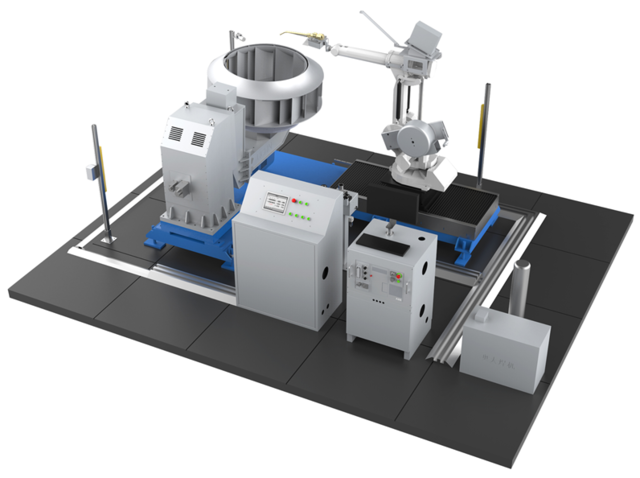
Welding centrifugal fan impellers was once an industry challenge. Traditional manual welding not only suffered from low efficiency and high labor intensity but also produced inconsistent quality. Now, robotic automated welding technology has arrived, completely rewriting the rules!
HOGI robotic welding system features advanced weld seam tracking technology, precisely identifying seam locations and dynamically adjusting welding paths. This ensures flawless adaptation to impeller complexities and consistent weld quality. Operation is remarkably intuitive—staff require minimal training to master it, and programming is effortless, significantly reducing time and labor costs.
Moreover, the robot operates 24/7 without interruption, substantially boosting production efficiency. Its high-precision positioning and stable welding process reduce defects, increase product yield rates, and enhance competitiveness while saving costs for enterprises.
Choosing robotic automated welding for centrifugal fan impellers means selecting an efficient, precise, and stable welding solution—pioneering a new chapter in fan manufacturing! #fanimpeller #axialfan
1 Current Status of Welding in Centrifugal Fans
Centrifugal fans are widely used for ventilation, dust extraction, and cooling in factories, mines, tunnels, cooling towers, vehicles, ships, and buildings; for ventilation and exhaust in boilers and industrial furnaces; for cooling and ventilation in air conditioning equipment and household appliances; for drying and conveying grains; as wind sources in wind tunnels; and for inflation and propulsion in hovercraft.
The welding quality between the fan casing and impeller directly determines the fan’s performance and appearance. Traditional automated welding equipment cannot achieve automatic welding due to its inability to track weld seams in real time, making manual welding the primary method.
2 Laser Vision-Guided Welding
Laser vision-guided automated welding machines revolutionize the fan industry by enabling automation and unmanned operation. This reduces the need for welding personnel while significantly enhancing weld quality and efficiency. Upon completion, welds guarantee structural integrity and aesthetic appeal without requiring manual polishing. This transforms traditional centrifugal fan manufacturing by overcoming its inherent drawbacks: low-end production, labor-intensive processes, and challenges in achieving mass production.
The equipment features simple operation requiring no complex training. Its laser vision system automatically locates weld seams, enabling non-contact, vibration-free welding that ensures both aesthetic appeal and reliability.
3 Basic Principles of Laser Vision-Guided Automatic Welding Machines
The system employs laser vision to automatically scan weld seam variations on fan housings, impellers, and other components. Visual scan data is converted and analyzed by a motion controller, which automatically controls the welding gun’s movement. This includes automatic execution of forward/backward, up/down, and rotational motions. Servo motors provide mechanical drive, enhancing the welding gun’s operational precision.
This equipment automates welding of fan housings, impellers, corrugated panels, container panels, and similar products, eliminating manual intervention during welding. Human operation is required only for pre-welding loading and post-welding unloading. Welding trajectories are automatically guided by vision cameras, while welding height is automatically adjusted by welding voltage.
Real-time monitoring of the operation is possible during runtime. Image sampling from the weld-guidance vision system can be displayed live on the touchscreen for manual oversight. Additionally, numerous welding parameters can be configured via the touchscreen. The equipment control panel includes buttons for start, stop, and emergency stop functions.
4 Automatic Welding Machine Operation Process
(1) Power on, supply gas, start machine;
(2) Manually place fan housing on positioner—no clamping, no mold, no precise positioning required; visual alignment suffices;
(3) Press learn button; positioner rapidly rotates one full revolution to learn weld seam position;
(4) After learning, press the start button. The manipulator locates the starting position and automatically welds (manual or automatic arc initiation possible; manual recommended);
(5) Upon completion, the machine automatically stops and sounds an alarm;
(6) Flip the workpiece and repeat step 2 to continue welding.
5 Welding Results and Comparative Advantages/Disadvantages
5.1 Disadvantages of Traditional Manual Welding
(1) Low efficiency requiring substantial labor;
(2) Poor weld quality and aesthetic appearance;
(3) Complex human factors making quality control difficult;
(4) Difficulty recruiting skilled welders and high labor costs;
(5) Low customer acceptance impacting corporate image;
(6) Inability to achieve economies of scale.
5.2 Features of Automated Welding Equipment
(1) Strong adaptability;
(2) Reliable, aesthetically pleasing weld quality with high efficiency, labor savings, and reduced production costs;
(3) Fully non-contact welding with zero vibration;
(4) Open system with adjustable parameters;
(5) Simple operation, easy to learn, with no requirements for workpiece positioning;
(6) Enhances corporate image;
(7) Supports remote debugging. The system incorporates an information module for cloud connectivity, enabling customers to monitor equipment status and perform remote debugging via terminal devices, thereby improving maintenance efficiency.
6. Technical Innovation Points
(1) Machine vision performs real-time scanning of workpiece weld trajectories;
(2) Simultaneous scanning and welding enhances welding efficiency;
(3) Elevates welding quality and product grade while ensuring welding stability;
(4) Simple and convenient operation requiring no programming, with easy maintenance;
(5) Networked equipment enables remote monitoring and debugging. By embedding an information module within the equipment, customers can achieve remote production management and equipment status monitoring. In case of equipment failure, remote debugging can be employed, significantly shortening the equipment maintenance cycle.
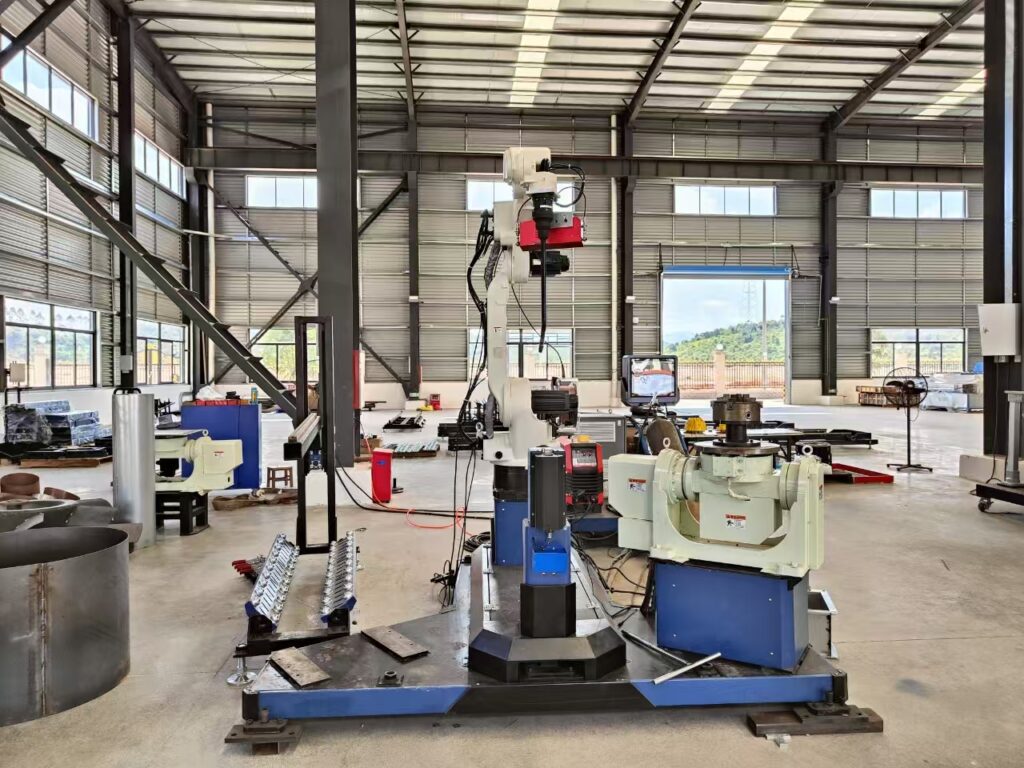
Fully Automatic Fan Impeller Welding Equipment
Product Name: Fully Automatic Fan Impeller Welding Equipment
Standard Load Capacity: 0.1T, 0.5T, 1T, 2T (Custom models available)
Dimensions: 1.8m x 1.8m (0.1T, 0.5T)
3.3m x 2.0m (1T, 2T)
Compatible Robots (Optional): ABB 1410; ABB 2600; Yaskawa Robots; Leading Domestic Robots
Welding Method: Vision-Guided Welding, Deformation-Free
Product Materials: Carbon Steel, Aluminum
Welding Efficiency: 10 units/minute, 2-4 times faster than manual labor
System: Vision Positioning System, Fully Independent R&D; Automatic Wire Feeding, Automatic Welding; No Teaching Required, No Programming Needed—Truly Intelligent Equipment
Welding Method: Vision-guided welding, distortion-free Product Material: Carbon steel, aluminum Welding Efficiency: 10 pieces per minute, 2-4 times faster than manual welding System: Vision positioning system, fully independently developed; automatic wire feeding, automatic welding; no teaching required, no programming needed, truly intelligent equipment
Automated Welding Solution for Fan Impellers
Fan Impeller Welding Application Case: Fully Automated Robotic Welding Solution for Fan Impellers. HOGI specializes in customizing fully automated robotic welding workstations for industrial robots, serving as your trusted expert in automated welding technology services.
Positioners are suitable for welding workpieces with welds on all sides.
Dual-station design enables simultaneous loading/unloading within the same work area during welding.
Workpiece handling is convenient and user-friendly, utilizing precision pneumatic chucks and other clamping devices.
Manual workpiece loading/unloading with robotic welding automation; a welding station operable by standard workers.
When switching between different workpiece types, operators input product parameters via the touchscreen interface to retrieve welding process parameters from the library, eliminating the need for teaching.
The fan manufacturing industry has experienced rapid growth in recent years. China’s domestic production rate for wind power equipment has reached 90%, with installed capacity ranking first globally. A fan—a mechanical device that increases gas pressure and discharges gas by inputting mechanical energy—is a type of driven fluid machinery.
In China, the term “fan” is a general designation for gas compression and gas transportation machinery, typically encompassing ventilators, blowers, wind turbines, and similar equipment.
With the transformation of China’s market economy system, fans have demonstrated significant market application potential across diverse industries.
Fans are now extensively used for ventilation, dust extraction, and cooling in factories, mines, tunnels, cooling towers, vehicles, ships, and buildings; for ventilation and draft extraction in boilers and industrial furnaces; cooling and ventilation in air conditioning equipment and household appliances; grain drying and conveying; wind tunnel air sources; and air cushion vehicle inflation and propulsion.
Large-scale fans are also relatively common, with continued capacity growth representing a prevailing trend in the global fan industry. Demand for medium and small-sized ventilators—which are both numerous and widely used—continues to increase substantially, though overall supply still exceeds demand.
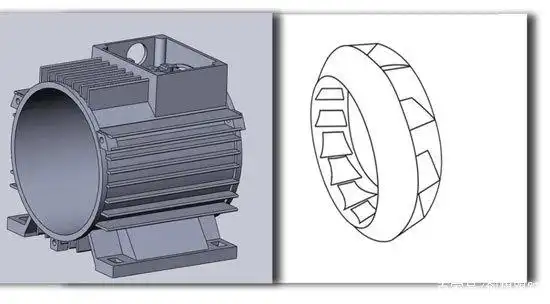
Fans comprise components such as impellers, housings, transmission systems, generators, control systems, and bearings, each playing an irreplaceable role. During fan manufacturing, the quality of the housing and impeller—critical components—directly impacts overall fan efficiency.
Therefore, the welding quality of these housings and impellers during the welding process is also pivotal to enhancing the efficiency of the entire fan system. #hogicncmachine