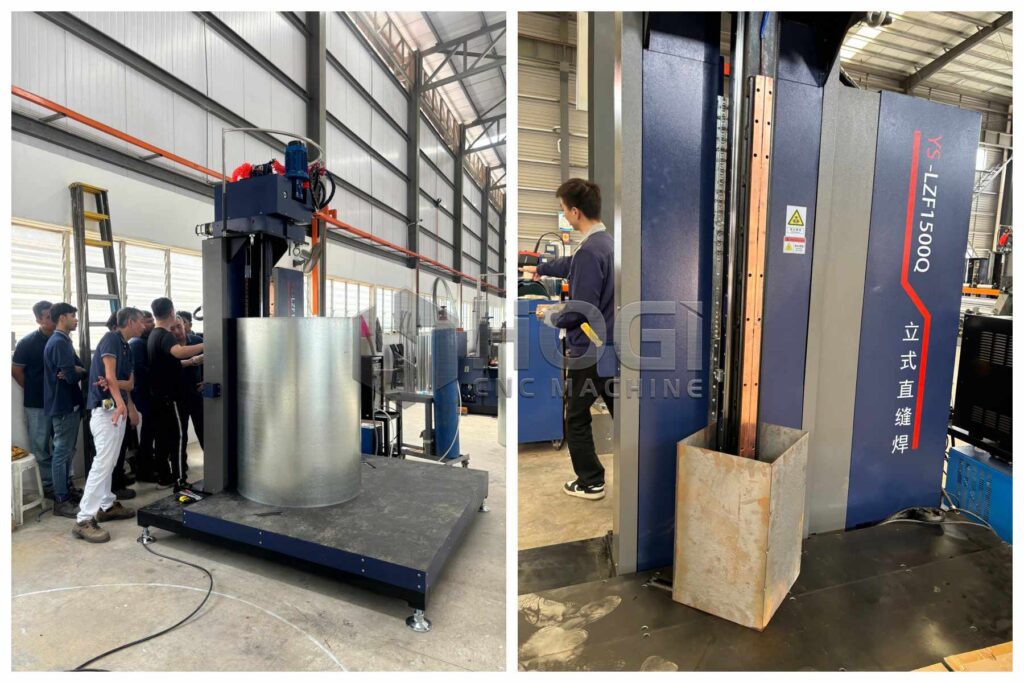
Product Name: Vertical Seam Welding Machine
Model Number:HG-LZF1500Q
Processing dimensions: [Round tube Dimensions ]≥250-1600,Thickness:1.0-3.0(mm)
Processing dimensions:【Square tube Dimensions】≥220*220,Thickness:0.8-2.5(mm)
(Custom sizes are available for special products, and brackets can be added to accommodate extra-large dimensions)
External dimensions:1900*1930*2810(mm)
Welding materials: stainless steel, galvanized steel, carbon steel, etc.
Product Applications: Widely used for straight seam welding of cylindrical/square cylinders of various specifications.
Product Name:Double-gun vertical straight seam welding
(Square and Circular Integrated machine)
Model Number:HG-LZF1500Q
Processing dimensions:【Round tube Dimensions】≥250-1600,Thickness1.0-3.0(mm)
Processing dimensions:【Square tube Dimensions】≥220*220,Thickness0.8-2.5(mm)
(Custom sizes are available for special products, and brackets can be added to accommodate extra-large dimensions)
External dimensions:1900*1930*2810mm(mm)
Welding materials:stainless steel, galvanized steel, carbon steel, etc.
Product Applications: Widely used for straight seam welding of cylindrical/square cylinders of various specifications.
Equipment advantages: Automatic square/round clamp changing, simpler and more effective operation, improving efficiency!
HOGI A high-tech enterprise specializing in the R&D, manufacturing, and technical services of industrial automation welding and cutting equipment, including vertical straight seam welders, CNC straight seam welding machines, lift-type straight seam welders, and other specialized straight seam welding machines. Our products are widely used in ventilation and environmental protection engineering, fire protection and civil defense, HVAC fans, automotive, landscaping machinery, construction machinery, pressure vessels, solar water heaters, firefighting equipment, mechanical manufacturing, and construction.
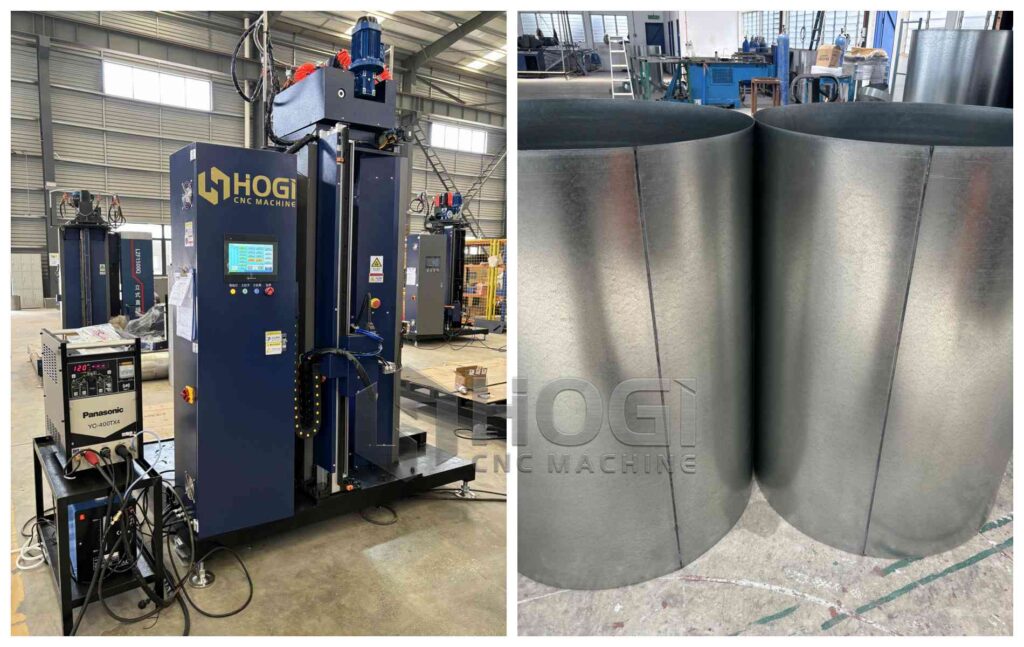
Automatic Vertical Longitudinal Seam Welding Machine
Suitable for a wide range of welding processes, including TIG, MIG, PAW, and SAW; capable of welding materials such as carbon steel, stainless steel, aluminum alloys, and aluminum profiles; equipment can be customized according to the structural requirements of the workpiece. Once the required weld length is achieved, the TIG welder stops operating. The servo motor system quickly repositioning, while the upper and lower workpiece clamping cylinders reposition, and the welding spindle reposition upward. The workpiece can then be removed. Proceed to weld the next workpiece.
HOGI Automatic Vertical Longitudinal Seam Welding Machine
1.It supports continuous, full-length or segmented welding, offering high precision and excellent stability;2.Depending on requirements, various welding methods such as TIG or MAG welding may be used.3.The cylinder clamping device ensures that the welding surface remains flat and free of distortion.4.A mandrel is inserted into a copper groove at the bottom to ensure adequate weld penetration.5.The welding gun’s movement utilizes TB linear guides and TB ball screws to ensure smooth welding.
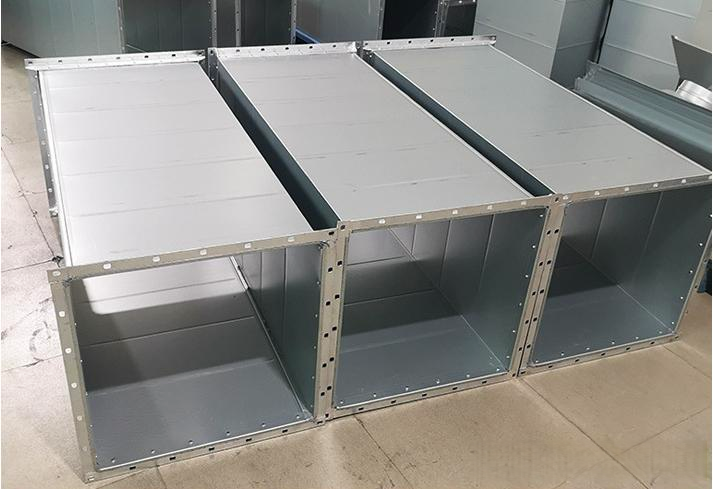
Rectangular welded ducts are a common type of ventilation ducting in modern buildings and are widely used in commercial, industrial, and residential settings.
It is made of high-quality steel, offering excellent corrosion and wear resistance, and is capable of withstanding prolonged use in harsh environments.
The key advantage of this type of ductwork lies in its welding technology. The use of high-strength arc welding ensures that rectangular welded ducts feature robust joints and excellent airtightness, guaranteeing the efficient operation and long service life of the ventilation system. Compared to traditional riveted ducts, the joints in rectangular welded ducts are more secure, making them less prone to leaks and air leakage, which significantly reduces energy waste and maintenance costs.
Rectangular welded ductwork also offers a more aesthetically pleasing appearance. Compared to traditional round ductwork, rectangular welded ductwork better aligns with the aesthetic requirements of modern architecture, featuring a cleaner, more elegant design. Additionally, these ducts can be custom-sized to meet specific needs, ensuring a seamless fit with the building’s design during installation.
Rectangular welded ductwork also offers excellent sound insulation properties. Because it is made of steel sheet, which has a higher density than other materials, it provides significantly better sound insulation. This is particularly important in environments that require a quiet indoor atmosphere, such as hospitals and schools.
In summary, rectangular welded ductwork offers excellent performance, an attractive appearance, and superior sound insulation. It has become an indispensable component of modern buildings. If you are considering installing a ventilation system, you should definitely consider rectangular welded ductwork. It will provide your building with an efficient, aesthetically pleasing, and reliable ventilation system, saving you significant amounts on energy and maintenance costs.
Longitudinally welded pipes are a common type of pipe, and their advantages include high strength and stability.
It is widely used in industrial, construction, and residential applications.
This article provides a detailed overview of the manufacturing and applications of longitudinally welded pipes, as well as their advantages and disadvantages:
一、Manufacturing
The manufacturing of longitudinally welded pipes primarily involves the following steps:
1. Sheet Cutting: Cut steel sheets into the required dimensions according to design specifications.
2. Roll Forming: Use a roll forming machine to bend the sheets into a circular shape, forming the pipe blank.
3. Welding: Weld the pipe blank along its length to form a continuous pipe.
4. Post-Processing: Perform surface treatment on both the inner and outer surfaces of the welded pipe, such as slag removal and polishing.
5. Inspection: Conduct non-destructive and destructive tests on the pipe to ensure its quality meets specifications.
二、Applications
Longitudinally welded pipes are widely used in the oil, natural gas, chemical, metallurgical, and power industries.
Its main applications include the following areas:
1. Transporting liquids and gases: Longitudinally welded pipes can transport various liquids and gases, such as petroleum, natural gas, water, and steam.
2. Steel structure engineering: Longitudinally welded pipes can be used to manufacture pipelines, bridges, tunnels, and other structures in steel structure engineering.
3. Urban construction: Longitudinally welded pipes can be used in infrastructure projects such as urban water supply, gas supply, and drainage systems.
4. Transportation: Long-welded pipes can be used to manufacture exhaust pipes for transportation vehicles such as automobiles, trains, and ships.
三、Pros and Cons
Longitudinally welded pipes offer the following advantages:
1. Excellent stability: Because they are welded, the joints of longitudinally welded pipes offer high strength and stability, making them less prone to leaks or gas escapes.
2. High production efficiency: The manufacturing process for longitudinally welded pipes is relatively simple, resulting in high production efficiency and enabling large-scale production.
3. Low cost: The manufacturing cost of longitudinally welded pipes is relatively low, making them suitable for large-scale production and application.
However, longitudinally welded pipes also have some drawbacks:
1. High welding requirements: Longitudinal welded pipes have stringent welding requirements and necessitate specialized technical expertise and equipment.
2. Prone to quality issues: The quality of longitudinal welded pipes is significantly influenced by factors such as welding techniques and materials, making them susceptible to quality issues.
3. Not suitable for high-pressure or high-temperature environments: Welded joints in longitudinal welded pipes are prone to cracking and other defects, making them unsuitable for high-pressure or high-temperature environments.
四、Conclusion
Longitudinally welded pipes are a common type of piping characterized by high strength and stability, and are widely used in industrial, construction, and residential applications.
During manufacturing and installation, factors such as welding techniques and materials must be carefully considered to ensure the quality and safety of the pipes.