1.Exceptional Welding Quality (Core Strength)
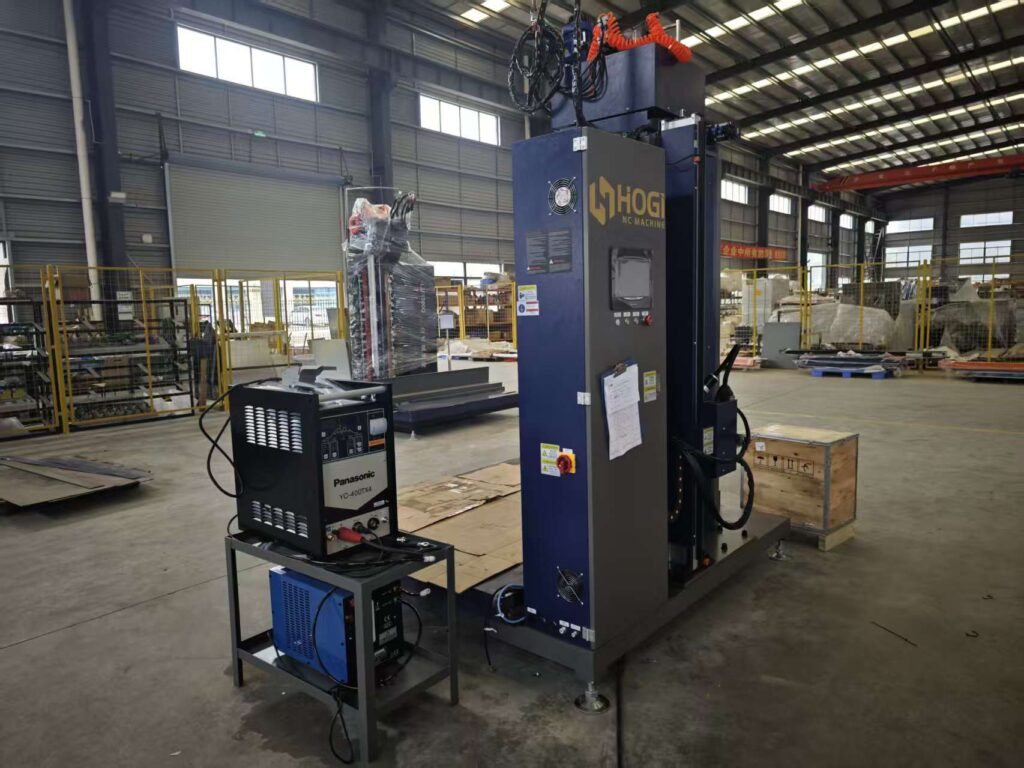
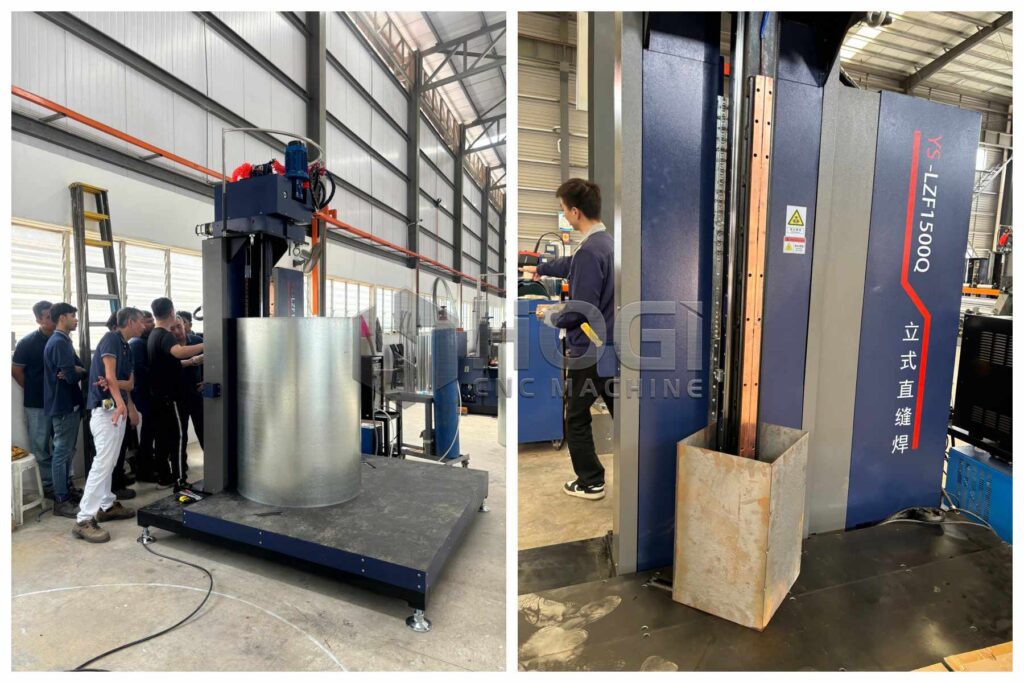
Vertical longitudinal seam welding machines are the core equipment for achieving automated, high-quality, and high-efficiency welding of long straight seams, and are particularly suitable for longitudinal seam welding of workpieces such as round cylinders, square tubes, and flat plates. Their key advantages lie in four key areas: weld quality, production efficiency, spatial layout, and operation and cost.
The weld has a perfect profile with minimal distortion.
Using a vertical-down welding position minimizes the effect of gravity on the molten pool, reducing the likelihood of sagging or runout. This results in a uniform, full-bodied weld bead free of depressions or spatter.
Equipped with a piano-key-style pneumatic clamping mechanism that applies uniform pressure along the entire length of the weld. Combined with copper heat-dissipating fixtures, this system rapidly dissipates welding heat, effectively suppressing thermal deformation and ensuring the workpiece surface remains flat.
It enables single-sided welding and double-sided forming, resulting in a smooth, continuous weld on the back side. There is no need for back-side root cleaning or secondary welding, which significantly improves weld density and strength.
2.High precision and excellent consistency
The welding gun is driven by a servo motor and a precision rack-and-pinion system. The track is precision-ground, ensuring smooth, vibration-free movement. Parameters such as welding speed, swing amplitude, and arc start/stop are precisely controllable throughout the entire process.
It supports intelligent features such as automatic weld seam tracking, arc sensing, and two-point teach-in positioning, automatically correcting deviations to ensure that the quality of long weld seams (up to several meters in length) remains completely consistent from start to finish, thereby completely eliminating the inconsistencies associated with manual welding.
Wide range of applications, suitable for various operating conditions
It can weld a variety of metals, including stainless steel, carbon steel, aluminum alloy, and galvanized sheet metal, with thicknesses ranging from 0.4 mm thin sheets to medium- and heavy-gauge plates over 3 mm thick.
Compatible with a variety of welding processes, including TIG welding, MIG welding, plasma welding, and laser welding, to meet welding requirements for different materials and strength specifications.
3.High level of automation, saving on labor costs
Fully automated process from workpiece positioning, clamping, and welding to unloading; one-button start; no manual adjustment of the welding torch required throughout the process; a single operator can oversee multiple machines simultaneously.
It automatically performs arc striking, arc extinguishing, torch oscillation, and parameter switching, enabling fast welding speeds (e.g., a 1.5-meter workpiece takes only 2–2.5 minutes), with production efficiency 3–5 times that of manual welding.
4.Continuous, stable operation, reducing downtime
The equipment features a highly rigid structure (e.g., cantilever beam annealing and stress relief), ensuring excellent stability during prolonged continuous operation and a low failure rate, thereby effectively reducing downtime caused by equipment malfunctions.
Supports seamless switching between continuous and intermittent welding to accommodate different production rhythms and maximize output.
5.Reduce post-processing steps
The welds have a smooth appearance and uniform color, eliminating the need for secondary grinding, polishing, or cleaning, allowing the process to proceed directly to the next step and shortening the overall production cycle.
6.Significant advantages in terms of space and layout
Vertical design, saving floor space
Compared to horizontal welding machines, the vertical layout significantly reduces the amount of floor space required, making it particularly suitable for scenarios where workshop space is limited and high-density production lines are needed.
Workpieces are clamped vertically, with clear loading and unloading paths. Combined with an automatic loading cart, this ensures smoother material flow and more efficient workshop layout.
Easier clamping and operation
Vertical clamping facilitates weld alignment and automatic positioning, enabling quick workpiece clamping and precise positioning. This reduces reliance on the operator’s skill level, allowing even novices to get up to speed quickly.
Key components such as the welding gun and clamping mechanism are arranged vertically, making it easier to perform maintenance, servicing, and replacement of wear parts, thereby reducing maintenance complexity and costs.
7.Overall Cost and Safety Advantages
Reduce overall production costs
Labor costs: By reducing reliance on highly paid, skilled welders, labor costs are reduced by more than 50%.
Material costs: Precise welding parameters ensure high utilization of welding wire and electrodes, resulting in minimal waste; minimal workpiece distortion leads to an extremely low rework rate, significantly reducing material loss.
Energy costs: Automated control, minimal waste heat input, and higher energy efficiency.
Improving Workplace Safety
Fully enclosed or semi-enclosed welding process, reducing direct exposure of operators to arc light, fumes, and spatter.Fully enclosed or semi-enclosed welding process, reducing direct exposure of operators to arc light, fumes, and spatter.
Typical Use Cases
Ventilation ducts, pressure vessels, and storage tanks: Longitudinal seam welding of cylindrical and square tubes, requiring both airtightness and strength.Automotive parts and sheet metal enclosures: Flat panel assembly and straight-seam welding of rectangular boxes, with a focus on high efficiency and minimal distortion.Stainless steel products and kitchen and bathroom fixtures: Welding of thin sheets; welds must be aesthetically pleasing and free of distortion.
By combining a vertical welding posture, automated control, and precision clamping with heat dissipation, the vertical straight seam welding machine effectively addresses the three key challenges of “quality, efficiency, and distortion” in long straight seam welding. It is the equipment of choice for modern manufacturing to achieve high-quality, large-scale, and low-cost welding production.